Wednesday, May 2, 2012

Future Tense


A series is generally a group of images that share some sort of common ground, while still being unique in their own ways, and taken all together, elicit some sort of response from the viewer. As I was constructing the idea for this project, I was fairly intrigued by images that drew the viewer's attention immediately.  So, I decided to go with a theme of stark contrast and/or multiple layers that caused the reader to look closer to understand the image as a whole.


In six out of the eight images, I used some common photos of trees as secondary photographs.  Both the fourth and fifth images contain a photo of the same tree.  I though that using a common image would draw the series together, giving the collection as a whole a greater sense of unity.  Moreover, in creating and thinking about the composition of the images, I used a fair amount of diagonal lines, (whether its the beams in the roof, the intersecting branches, or the lines of the shadow of the window).


Future Advice for a Future Tense Photographer: A theme is a crucial part of successful execution.  I was a little bit wavering on my theme.  So, as a little bit of advice, I would say its good to have a theme from the beginning, and take photos based on that theme, not create a theme out of the photos you have taken.  That way, the images as a whole have a greater sense of cohesiveness.

Monday, February 13, 2012

Kill Your Darlings, Fibonacci


Throughout the project I faced inescapable adversity of time and place.  Being limited to just one weekend to take our first role of film, I had to use the resources that I had to get new and not-so-normal pictures.  I therefore decided to base the series on a sense of normality, allowing me to use everyday objects, photographed in a new and unseen way.


One of the photos that I killed was a really intriguing photograph taken through a window, viewing the variety of plants outside.  It had a very unique look to it, for the borders and surrounding areas of the window, which was an unusual thin vertical rectangular shape), a stark black.  I really enjoyed the high contrast of the dark surrounding of window, versus the lighter shades looking through the window, outside.  Although, however much I enjoyed the image, it did not play into my mood and the ongoing series as I could have hoped, so it was necessary that it be killed.


The photograph I selected for the display in the library foyer was executed in such a way that it played with the mood of normality that I explained earlier, while still being unique and new.  It also went quite nicely with the forming series of the class' compilation.


Yes, I believe that overall I had similar views to those of my classmates.  Someone suggested that I reprint some of the images in an attempt to get the lighting and whites and blacks just right.  I completely agree in the sense of adjusting the colors, for some of the images demanded a bright, bright area of white (from the sun), and it was interesting to hear others' responses on how they took this.

Monday, January 9, 2012

Stop Motion Project - To Build a Mountain


         There is a lot of difficulty in creating a story with just photos, some props, and only a minute to do so.  These restrictions lead to interesting takes of stop motion projects.  The story-line of To Build a Mountain followed some fingers (portrayed as a person, or creature) as they went about building a mountain with various rocks.  The pinnacle point of crisis occurred after the mountain was constructed, and after the flag was put up, when everything came crumbling down.  Logistically, the variation of imagery and the choice of music shaped the final product by giving the viewer a sort of backdrop to go off of.  The music I selected was "Houdini," by Foster the People, and the reason I chose it was for the quirky eclectic sounds that it has; I thought it would go well with the unique imagery of the project.  Overall, the photography part went surprisingly well, with quick, simple moves, I was able to create the whole storyline in just a few days of shooting.  Also, I needed to draw on expressions to some of the pictures to give the character emotions, connecting it to the viewer a bit more.  In total, I believe everything went quite well, however if I was to do a similar project in the future, I might alter a few things.  For one, I would use a backdrop or background that is a bit more interactive and moves a little more, I just think it would be more interesting for the viewer to have other things to look at.  Lastly, in hopes that it would produce a more fluid storyline and final product, I would focus on a story that has a little more dramatic arc.

         If I were to do another stop motion movie, using the same or a similar premise, I would use a black background.  I feel like this would better accentuate the colors in the film.  Also, I would incorporate mirrors and other interesting props to give the movie a greater sense of mystery and craziness.

Wednesday, November 2, 2011

House of My Mind

The House of My Mind project aim was to capture the essence of a house-like feeling or environment, and, using photoshop and newly learned techniques, blend together and incorporate multiple images to create a unified final project.


My final project was quite successful in the notion that I accomplished many of the new skills, such as masking, that we learned how to do in photoshop.  The valuable skill of being comfortable with editing and manipulating photos in a digital setting helped me create images that gave insight to who I am, and what my mind is like.  In the beginning, I had intentions of photographs that used only a few images, using simple tools, to make a fabricated image of something house-like.  However, as I became more comfortable in the computer setting, I began to take different paths with my editing.  I developed my craft and stretched and explored with the new techniques, especially with the comparison of my first photograph, seemingly less advanced technically than the later ones.  I feel that now I have refined my craftsmanship to a wider area of capability.  I grew from a person quite unfamiliar to the whole Photoshop thing, to one who can easily navigate.  My "Thought Process" image, which was the one I made first, compared to the others, shows my growth from earlier in the year up until now.  One can see the progression of a beginner to masking to a master, not really, but a better one anyway.

Tuesday, September 6, 2011

Transforming Materials

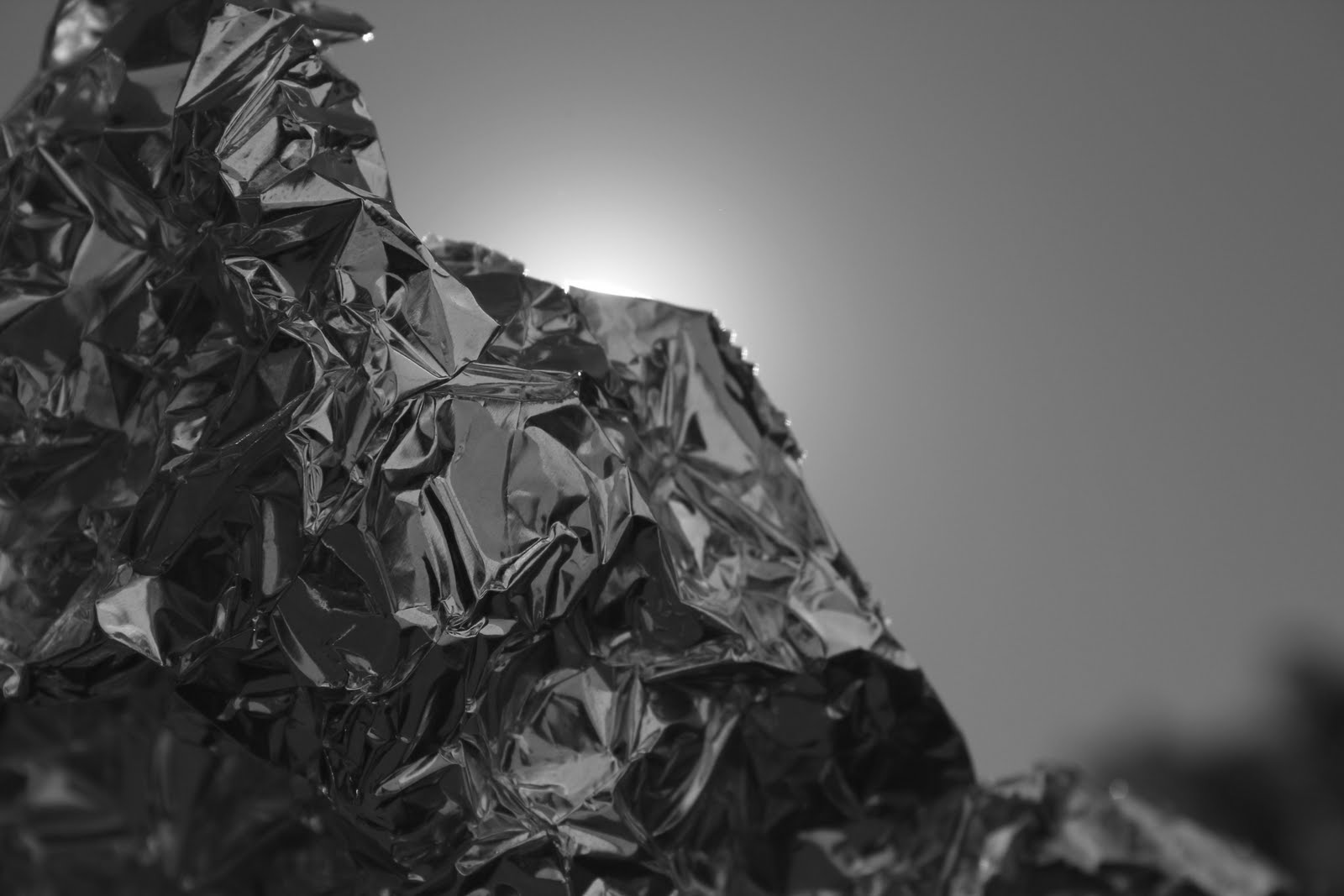
The Transforming Materials project aimed to photograph everyday materials, while incorporating them into the surrounding environments.


My final product does indeed relfect my intentions for this project.  In the beginning, I had hoped to utilize unique lighting, the sun or an unnatural source, to capture images that would make the reader question the identity of the content.


I think my final products took a totally different direction from what I had pictured in the beginning, but in a good way!  I think that I first imagined having a series of all black and white images of tinfoil, and just crumpling it.  However, I think the direction went in a completely different way in that I manipulated - or transformed - the materials so that the viewer would have to question the identity at first.


Wednesday, June 1, 2011

Final Reflections

1) Before the year began, I was excited to begin taking photography, having not had the opportunity to take the class beforehand.  I had taken may pictures with my mom's digital DSLR camera, but never film, so I knew a little about ISO, shutterspeed, and Aperture, but only a little.

2) Throughout the year, I feel like I have most needed to cultivate the skill of composition.  When taking a photograph, it is much better to look in every corner to see that what you can see through the lens is exactly what you want your photograph to look like.  In Aperture and Photoshop, you can crop images, but in the darkroom it was important to keep composition in mind when taking the photograph, so as not to warp the picture when cutting it or enlarging it.

3) The skill of composition and previous skill that I had coming into the class were helpful because I could use past knowledge to answer my own questions.  Also, with my work on composition, I now try to take a photograph exactly at the size I want it, with the borders of what I see on the lens exactly as I would like to see it on the paper.  In other words, I am trying not to take advantage of cropping as much.

4) I have realized that I need to improve my digital editing skills.  Some of the procedures needed to edit a photograph in Aperture or Photoshop are necessary tools in making a picture better, and if I learned a little more about each program I could improve on this quite a bit.

5) To improve these skills, I have practiced using Photoshop to better assimilate myself to the process of editing digital photographs.  Just playing around and see what I can do makes a difference, but also using the powerpoints we were given to accomplish the more complex procedures.

6) What I am most excited about photography right now is the fact that I have the ability to take a camera anywhere I want, take pictures, and edit them to be perfect, using just a camera, and a computer.  I like that fact that I have learned what it takes to crop, solarize, vignette, or in any way edit a photograph.

Monday, May 30, 2011

Portrait Project

The goal of the Portrait Project was to learn how to compose a photograph of a person, having planned out the composition before hand, meaning they were not candid.  My favorite photograph of the collection bellow is the last, because of the slight vignette, (which was an accident, the camera had a malfunction).  I also like the fact that the person is not looking at a camera.